
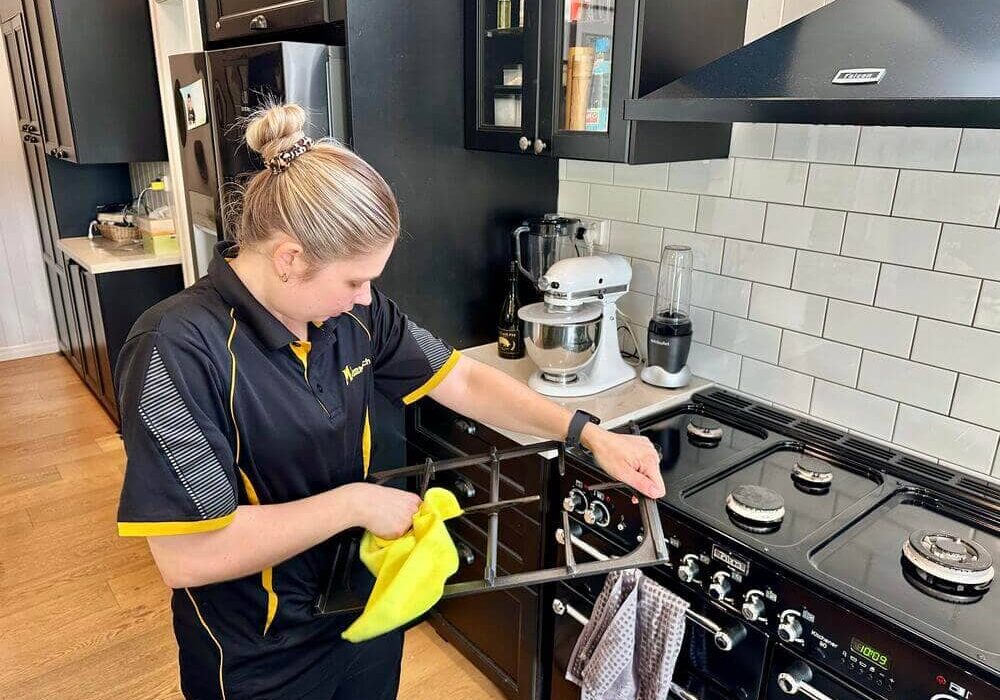
The smell of a good stir-fry filling the kitchen can be heavenly. But the smell of burnt food gunk? Not so much.
Grease splatters, food spills, and other residue can easily accumulate on stove top grates, creating a hygiene and safety risk. Keeping a clean stove is a key part of good kitchen maintenance!
Here, we’ll walk you through how to clean stove top grates, with these methods:
- Dish soap
- Baking soda
- Bar Keepers Friend
- Ammonia
Keep your stove top in grate condition so you can cook the food you love, to your heart’s (and tummy’s) content.
How Often to Clean | Before Cleaning | How to Clean | Cleaning Uncoated Grates | Removing Stains | Seasoning
What Type of Stove Grates Do You Have?
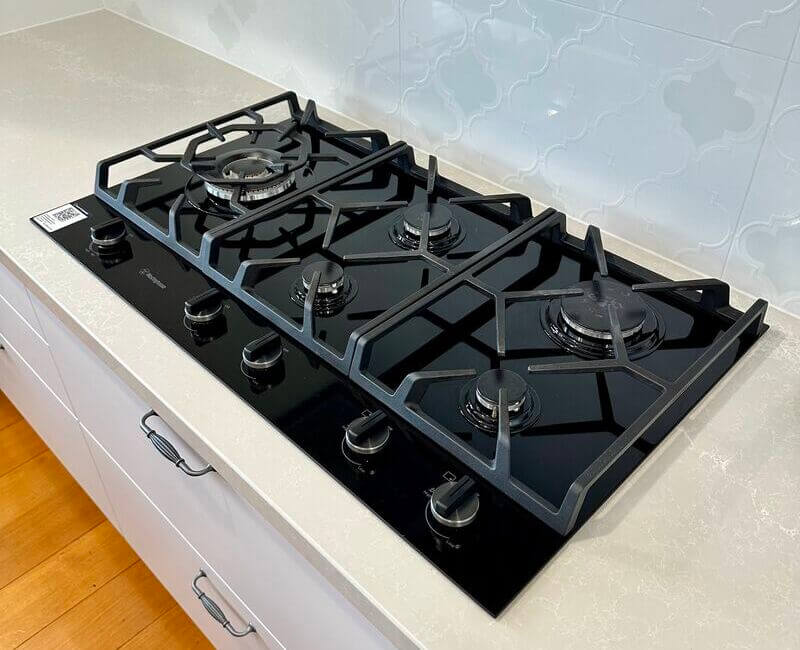
Stove grates (or gas grates) sit on top of a stove to hold your cookware over the burner caps. They’re most commonly paired with traditional stainless steel stoves, but can also be found on gas-on-glass cooktops.
Modern grates are porcelain-coated cast iron, a durable material that can withstand high temperatures. But there are a few other types as well!
| TYPE | OVERVIEW | CLEANING TIPS |
| Porcelain-enamelled cast iron | Most modern gas stovetops have cast iron grates with a porcelain-enamel coating. This protects them from degradation. | The coating makes the grates easier to clean. However, since they’re usually black, residue or stains may not show up as readily. |
| Uncoated cast iron | Older gas stoves have uncoated grates, which typically need regular “seasoning” to create a protective layer. | Minimise moisture used when cleaning uncoated gas stove top grates to prevent rust. |
| Porcelain-enamelled steel | These are more common for BBQ grills, but some gas stoves have enamelled steel grates. | Since the coating is similar, you can clean steel grates the same way as enamelled cast iron ones. |
You can identify coated cast iron by the smooth finish with a slight sheen after cleaning. Uncoated cast iron has a more matte finish and a rougher texture from long-term use.
If you’re unsure, check the stove’s manual or the manufacturer’s website. Or peek under the grates — sometimes there’ll be a label to tell you!
How Often to Clean Stove Grates
Regular cleaning keeps your grates in good condition, so here’s a good schedule to aim for!
| Grease spills or messes | Tackle straight away once the grates have cooled |
| Quick wipe down | After every use with a damp cloth, then a clean cloth to dry |
| Deep cleaning | Every 1–2 weeks to prevent a buildup of grease or stuck-on food |
A clean stove top contributes to a safe and hygienic kitchen. Grease splatters, food spills, and other grime can build up over time and create a potential fire hazard.
The residue could also lead to mould or wear down the porcelain coating and damage the material.
Before Cleaning Your Stove Grates
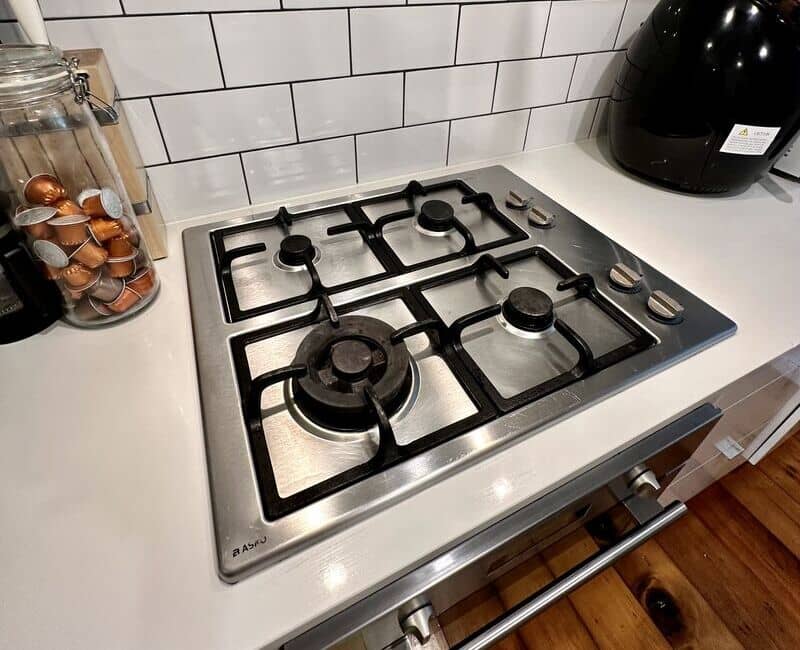
A little preparation goes a long way before scrubbing. Choosing the right cleaner and tools will save you time and effort — and help you avoid accidentally damaging the grates, too.
Of course, you can always book a full kitchen clean with Maid2Match and let us tackle your stove top and grates for you!
Best cleaners for stove grates
The best ways to clean cast iron stove grates are with dish soap or baking soda paste. Both are effective for routine maintenance or tackling mild buildup.
For more stubborn dirt, opt for a commercial cleaner like Bar Keepers Friend. Ammonia is also effective, but be very careful and try not to use it too often since it’s quite harsh.
Besides your chosen cleaner, you’ll need a non-abrasive scrubbing pad or sponge, or a stiff-bristled nylon brush. Don’t forget a microfibre towel to dry.
What not to use when cleaning stove top grates
Avoid using highly abrasive tools, such as metal brushes and scouring pads. These can scuff the protective finish on coated grates, leading to rust.
Skip the steel wool as well for coated grates, though ultra-fine wool (#0000 grade) may work on uncoated grates.
Do not use bleach as it could strip or corrode the finish or leave a hazardous residue. The same goes for oven cleaners, which are not formulated for stovetop grates and could damage the enamel coating.
BBQ grill cleaners are a safer alternative to oven cleaner if you need a stronger solution.
Can you put stove grates in the dishwasher?
You may wash cooktop grates in the dishwasher only if the manufacturer allows it. A dishwasher could damage the coating, and it likely won’t remove all the dried or burnt-on residue anyway.
Washing by hand is less of a risk and results in a more thorough clean.
Preparing to clean the grates
Always make sure the stove is off and the whole surface has cooled to minimise the risk of injury or burning the cleaning products. Once cool, remove the stove burners and set them aside to wash separately.
If you can, switch off or disconnect the gas to make things safer.
When taking the grates off the stove, lift them straight up (and set them straight down afterwards). Sliding the grates scratches both the coating and the stove surface.
Check the owner’s manual or website for specific instructions or products you shouldn’t use. You don’t want to void your warranty!
Finally, make sure to wear rubber gloves while working to protect your skin. If you’re using a strong cleaner, a face mask keeps out any fumes.
How to Clean Stove Grates
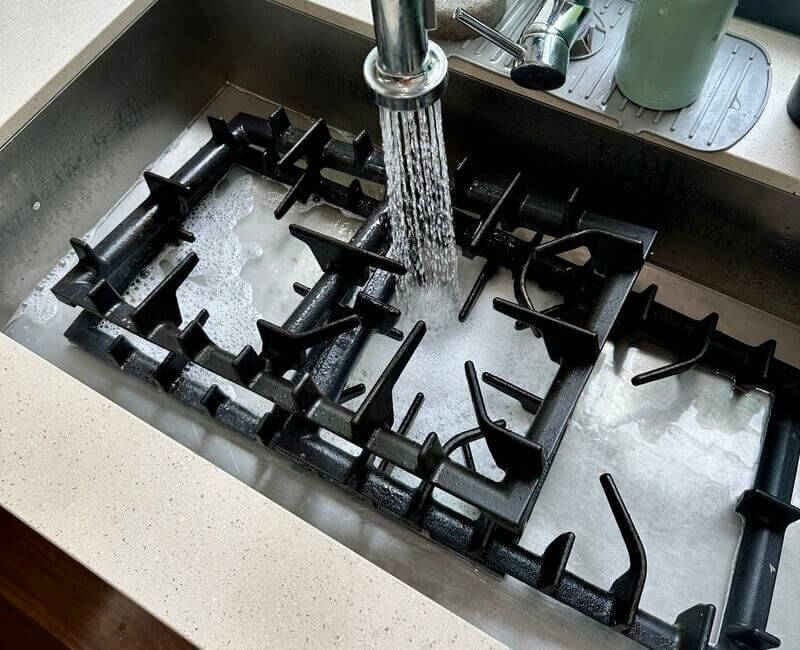
Since stove top grates are so sturdy, they’re easy to maintain. The cleaning process will be the same for both porcelain-enamelled cast iron and steel grates.
However, if you have uncoated grates — or if the coating has cracked — skip ahead to the next section. You shouldn’t expose bare cast iron to too much water.
With dish soap
STRENGTH: Mild
EFFORT: Easy
For everyday grime and light buildup on stove grates, washing with soapy water is enough.
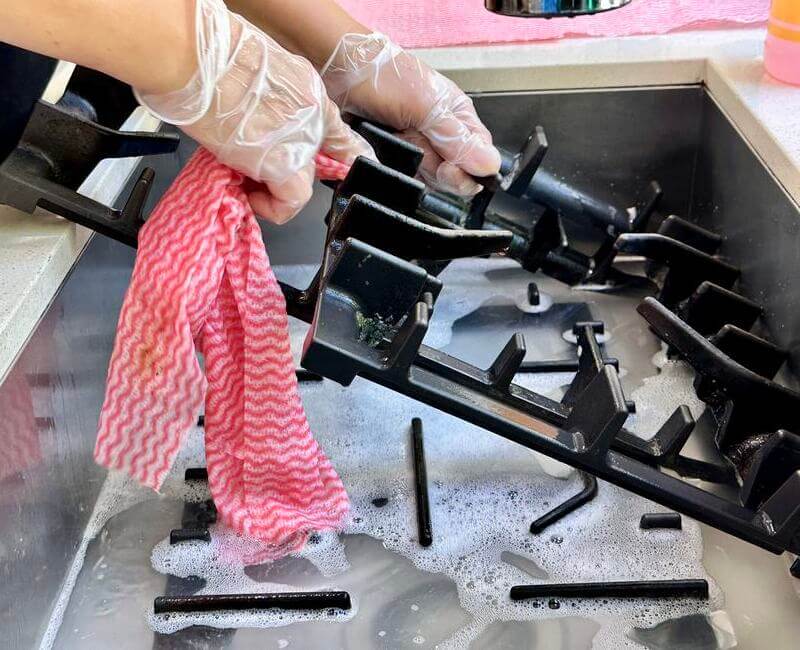
Fill the kitchen or laundry sink with hot water, enough to submerge the grates. Add a generous squirt of dish soap (about 1 tsp) and mix until sudsy. Use a cooking tool, like a wooden spoon, so you don’t get scalded!
Let the grates soak in the hot, soapy water for 10–15 minutes to loosen the grease and dirt. Then use your non-abrasive scrubbing pad or sponge to scrub the grates clean.
Rinse with more hot water before drying the grates thoroughly with a microfibre cloth.
With baking soda
STRENGTH: Mild
EFFORT: Moderate
Baking soda is a mildly abrasive cleaner, so it’s safe to use on coated stove grates. Plus, since it’s alkaline, it’s effective at tackling grease or oil residue!
Work in the sink, as this method can be pretty messy.
Make a paste with 3 parts baking soda to 1 part water. (Optional: 1 tsp dish soap for added cleaning power.)
Spread the paste over the stove grates with a damp sponge and leave it to work for 20–30 minutes. Don’t let it dry out, though, as it becomes harder to scrub away.
Afterwards, go over the grates with the sponge to remove the grime. Rinse off the baking soda residue or, if you want, wash the grates with some soapy water.
Wipe clean and dry with a soft cloth.
With Bar Keepers Friend
STRENGTH: Moderate
EFFORT: Moderate
This is a levelled-up version of the baking soda paste — this time with Bar Keepers Friend. It’s also a mildly abrasive cleaner but contains oxalic acid, which can break down mineral or organic stains.
Be sure to use this as a paste so you don’t scuff the coating!
Follow the package instructions for applying the product onto your stove grates.
Scrub the grates clean with a soft sponge, then give them a good wash in soapy water to remove any residue. Dry with a microfibre cloth.
With ammonia
STRENGTH: Strong
EFFORT: Easy
This should be your last resort when cleaning cast iron grates, since ammonia can be hazardous. But if other methods don’t work — say, for years of baked-on grease — it’s very effective.
Check your local council regulations on hazardous household waste beforehand, so you can dispose of the ammonia properly.
Always work in a well-ventilated space, ideally outdoors. Wear protective equipment such as rubber gloves and a face mask.
Never mix ammonia with anything while cleaning. If you used a different cleaner first, wash the grates thoroughly and wait 24 hours before trying this method.
Take a large rubbish bag that can fit your stove grates inside (double up if needed). Place the grates inside and add half a cup of ammonia. No need to cover the grates, as the fumes do the work!
Tie the bag shut and leave it lying flat overnight. Don’t forget to wash your hands afterwards.
Then take the grates out the next morning and dispose of the ammonia according to local regulations.
While wearing gloves, scrub the gunk off the grates with a soft sponge or scrubbing pad. Rinse the grates thoroughly before washing them in soapy water. Then wipe them dry with a soft cloth.
How to Clean Uncoated Cast Iron Stove Grates
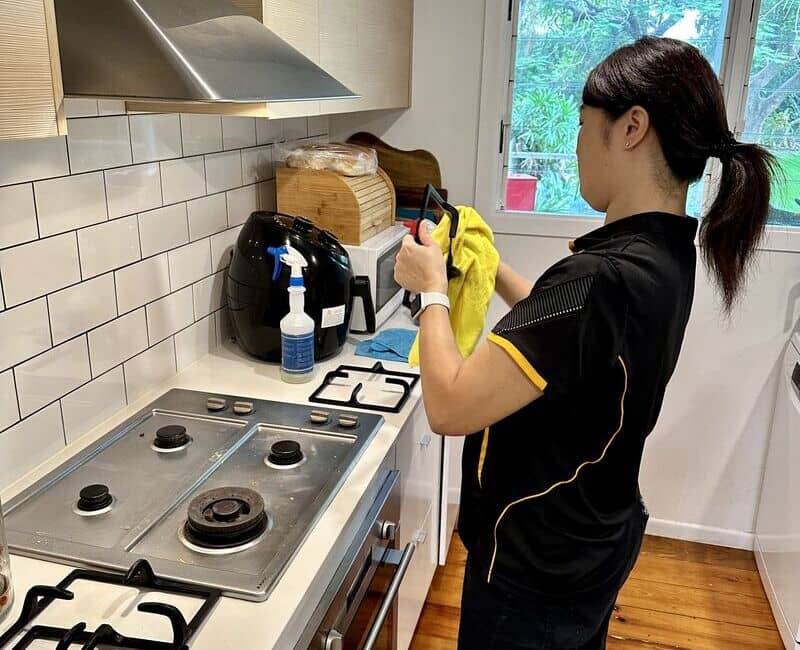
If you have uncoated cast iron grates or standard ones with a chipped finish, you should avoid soaking them in water. Trapped moisture can lead to rust, which weakens the grates over time.
Instead, mix a few drops of dish soap in a bowl of hot water. Dip a soft sponge or soft-bristled brush into the mixture and wring or shake out the excess moisture. Carefully scrub the grates clean.
For baked-on food, apply a small amount of a paste made with 3:1 parts baking soda and water. Work it over the surface with a lightly dampened sponge.
Once the grates are clean, remove any residue with another damp cloth. Wipe them immediately with a clean towel — they shouldn’t be left to air dry!
Removing Stains from Gas Stove Grates
Even with routine cleaning, your stove’s grates can develop stubborn stains over time. Baked-on grease or food, alongside rust, are the most common culprits.
Fortunately, you can tackle most stains with products already in your kitchen!
How do you get baked-on grease off cast iron stove grates?
For coated grates, a good soak in hot, soapy water is usually enough to loosen burnt grease and food. You can add a cup of baking soda to the water for extra cleaning power.
Leave the grates for 15–20 minutes before scrubbing. You may need to repeat this once or twice to get all the grease off.
However, for very stubborn residue or heavy buildup, a stronger solution is more effective. You can use a compatible BBQ grill cleaner or the ammonia method. Remember to wear protective equipment and work in a well-ventilated space.
How to remove rust from cast iron grates
For small rust spots, try a baking soda paste (3 parts bicarb to 1 part water). Apply a small amount to the rusted areas and cover them with some cling wrap so the paste won’t dry out.
Leave the paste to sit for up to an hour, then work it into the grates with a damp cloth or sponge until the rust lifts. Wipe off any residue before drying.
For larger amounts of rust, you can try a solution of equal parts white vinegar and warm water. Soak some paper towels in the mixture, then wrap them around the rusted areas and leave for 3–5 minutes.
Do not let them sit for more than 10 minutes so the acid doesn’t etch the material.
The acetic acid in vinegar reacts with the metal compounds in rust, making them easier to remove. Scrub off the rust with a soft-bristled brush before wiping away residue and drying.
If you’re cleaning uncoated grates, try #0000 ultra-fine steel wool. Keep it damp while scouring off the rust so it’s not too abrasive. Season your grates afterwards — see the next section!
How to Season Cast Iron Grates
Much like cast iron pans, seasoning helps protect uncoated grates, and the process is similar.
You should only need to do this once at the beginning (since regular use will maintain the seasoning) or if you’ve cleaned with a strong method like ammonia.
Porcelain-enamelled gas grates don’t need seasoning, since they’re already coated.
Take a cooking oil with a high smoke point, such as canola, vegetable, or grapeseed. Apply a thin layer all over the grates with a basting brush or soft cloth. Buff the oil into the surface until it no longer looks greasy.
Skip the paper towels — they often leave behind lint that’s annoying to remove.
Quickly wipe off any excess oil before placing the grate onto a lined baking sheet. Then “bake” them in the oven at 180ºC (350ºF) for about an hour. Run the exhaust or open some windows if it gets smoky!
Switch off the oven and let the grates cool down before taking them out.
Keeping Your Stove Grates in Good Condition
Minimise spills and messes when cooking by using pot covers or lids. Use correctly-sized pots as well to lessen the risk of something boiling over.
Wipe the stove top and grates after every cook, ideally while the stove is just warm to touch. Preventing grease and food buildup means less scrubbing later on!
Lift and set down pots with care so you don’t accidentally chip or scrape the porcelain-enamel coating. Avoid sliding anything around so you don’t scratch your stove top.
More to Know About Stove Grate Care: FAQs
We’ll break down a few other common concerns about maintaining your stove’s burner grates here.
How can I prevent stove grates from rusting?
You can prevent rust on cast iron grates by minimising moisture contact. Rust comes from the corrosive reaction of iron, oxygen, and water.
Wipe the grates after cooking, dry them immediately after cleaning, and store them in a dry place when needed.
Seasoning your uncoated grates also creates a protective layer that keeps out moisture!
Does vinegar destroy cast iron?
No, vinegar doesn’t destroy cast iron, but it can etch the metal or cause pitting on bare cast iron with prolonged contact.
When using vinegar to treat rust on uncoated cast iron, do not let it sit for more than 10 minutes.
Monitor the material for small rough spots or holes for a day or two afterwards — those indicate damage.
Does vinegar and baking soda clean stove grates?
Vinegar and baking soda can both clean your stove grates separately.
However, using them together renders them ineffective, since they neutralise each other to create water and salt.
Stick to using baking soda for scrubbing and vinegar for spot-treating rust!
Can you clean a stove grate in a self-cleaning oven?
Do not run gas stove grates through an oven self-cleaning cycle unless the manufacturer allows it.
Some grates have rubber bumpers or feet, which can melt in the oven and give off harmful fumes. The extreme heat of a self-cleaning cycle (up to 500ºC) can also damage enamel or warp cast iron.
Stick to cleaning your grates by hand so it’s safer!
How to make stove grates look new again?
Regular cleaning and scrubbing off grease or food buildup helps maintain the appearance of your stove top grates. Seasoning uncoated grates also helps create a more uniform finish.
However, regular wear and tear — especially if you cook a lot — will affect the appearance of the grates over time. Just think of it as another sign of a well-used kitchen!
